
You’ve been invited to deliver a presentation to senior stakeholders and influence beyond your title. What is the story that begins running in your head?
Do you immediately focus on the value you can offer?
Or do you hesitate and question whether you truly belong in the room?
For leaders, the difference between these two responses is rarely capability. It is the backstory running quietly in the background, shaped by past experiences, not present reality.
It’s a story that gets activated under pressure. And most leaders are unaware it’s even running. Though it is this invisible story that carries a cost.
RESEARCH: Nearly two-thirds of high-performing professionals experience imposter syndrome. High achievers in senior positions are more likely than average to experience it, not less. This isn't a personal weakness. It's an invisible backstory and invisible stories can be rewritten.
The backstory that erodes confidence in real time
At a recent leadership development session, a participant —we’ll refer to as Clara — had received feedback on multiple occasions that she needed to be “more confident.” This came as a surprise. In her mind, she was confident.
The evidence backed her up. She was regularly invited to present to very senior leaders, a clear signal of trust and credibility. The feedback made no sense to her. She couldn’t attach it to anything she felt or recognized in herself.
Then, in the training session, she described one of those opportunities to the group. Without realizing it, she added a qualifier: “it is not typical for someone in my role”.
The room witnessed the shift happen in real time. Her voice softened. Her eye contact broke. Her energy dropped. She didn’t notice it. The room did.
The participants shared specifically what they observed. For the first time, the general feedback she had received multiple times, “more confident”, had a reference point. She finally understood what others had been seeing. In that moment her backstory overshadowed her capability.
Nothing changed about her value or expertise. Only the invisible ‘unconscious’ story activated by qualifying her own right to be there. What began as excitement about visibility morphed into self-doubt.
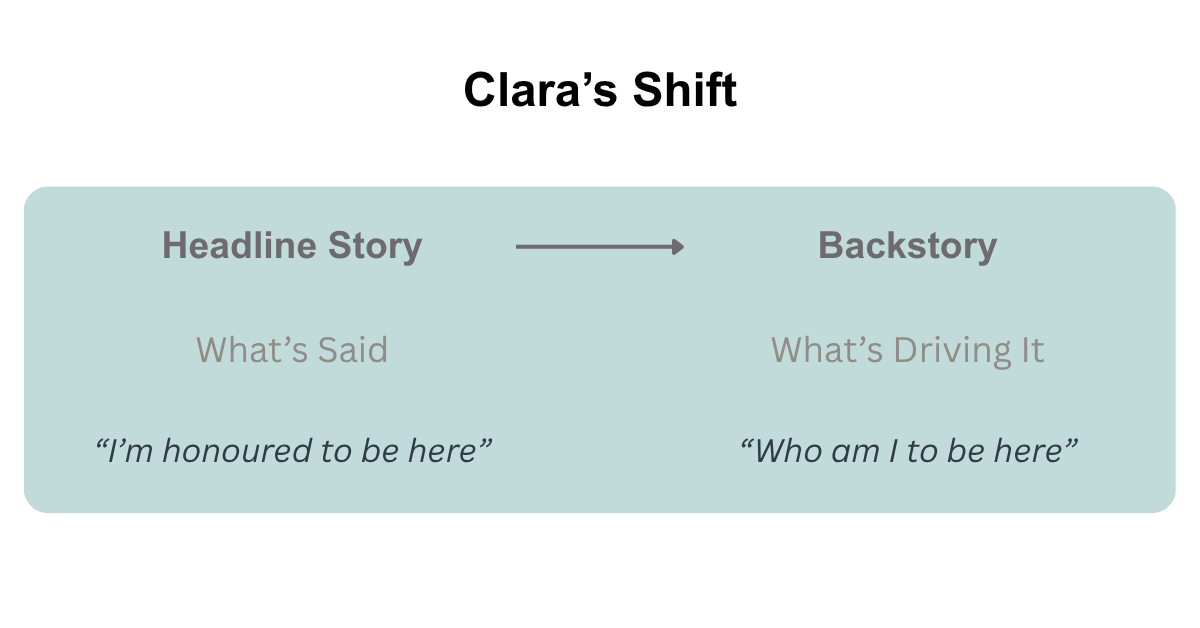
The shift is subtle. It shows up in your body language, your tone, or the qualifier you slip into your sentence, having the power to undermine your credibility.
Clara’s experience isn’t unusual. It happens across levels, industries, and experience: whenever a capable leader’s backstory isn’t aligned with their current state of being. And because it runs below conscious awareness, feedback about confidence without specifics has nowhere to go. There is no felt experience to attach it to, until someone shares what they see.
If you’re in the room when someone’s story shifts their energy, sharing what you witnessed is a true leadership move.
NOTICE THIS
Pay attention to when your language starts to qualify your value: “I know this isn’t typical for my level…” Your backstory has surfaced. That’s your cue to interrupt it and reset.
Presence is established by credibility, not your title
Clara was exactly the right person senior leaders needed to hear from. She had the expertise, along with the courage to deliver the full message, both the innovative insights and the uncomfortable truths.
Instead of grounding herself in why she had been chosen, her backstory quietly destabilized her confidence. Leadership presence is not earned by title. It is established by clarity, credibility, and the experience you create for others.
When the unconscious backstory takes over, your impact diminishes even while your competence remains fully intact. That is the hidden cost.
RESEARCH: Psychologists Pauline Clance and Suzanne Imes first identified this in high-achieving professionals: despite outstanding accomplishments, these individuals persist in believing their success was due to luck or effort rather than ability and live in fear they cannot repeat it. Because the backstory runs below conscious awareness, even repeated feedback about confidence can fail to produce change. The phenomenon is most acute in moments of high visibility.
BEFORE YOU WALK IN
Set yourself up for success by preparing yourself mentally and physically. Develop rituals that ground you, reinforce your value, and empower how you show up.
Five moves to step in front of your backstory
The backstory surfaces without realizing it, preparation isn’t optional, it’s the earliest and most reliable place to interrupt it. Left unattended, it shows up in your body language, your tone, your word choice, and your decisions. These five moves interrupt that pattern and reground your presence.
MOVE 01
Anchor in evidence of why you
You were invited to lead for a reason. Leadership is not about what is typical it is about living into your potential. You do not need permission to contribute value.
GROUND YOURSELF Write down three specific reasons you were asked to present. You were a deliberate choice. Remind yourself what that was based on.
MOVE 02
Decide who you are before you walk in
Enter every high-stakes interaction clear on who you are and how you want to be known. When your identity is defined, the backstory loses its foothold. This keeps you on brand before you’re even in the room.
GROUND YOURSELF Choose three words that define how you will show up: clear, direct, present. Write them where you’ll see them before you begin and define what they mean to you. Let those words lead your actions, not your backstory.
MOVE 03
See people, not titles
Titles signal experience and role responsibility, not having all the answers. Everyone is present to achieve a unified outcome. Another leaders’ title never changes the value you bring.
GROUND YOURSELF Before you enter, humanize everyone around the table. Think of the senior leaders as your partners in solving what matters together. Be curious about what is important to them.
MOVE 04
Prepare so you are present
Know your material well to be attentive to your audience. Giving you space to read the room, adjust in real time, and deliver a message with clear outcomes instead of reciting what you rehearsed. Purposeful preparation creates impact and impact builds credibility.
GROUND YOURSELF Identify the single idea you want your audience to understand that matters most. Deliver your message around that and communicate to influence the desired outcome.
MOVE 05
Optimize your energy
Confidence is communicated before you use your words. Research confirms that how you carry yourself affects how others perceive you, though more importantly how you perceive yourself. The goal is authentic presence, accessed through intention.
GROUND YOURSELF Slow your pace. Hold eye contact. Finish your sentences as statements, not questions. If you feel a shift in your energy or focus, remember your body and your inner voice are both tools. Use them.
Your leadership move
Leadership presence begins with authorship.
If you don’t intentionally write the story you bring into critical moments, your backstory will write it for you; often quietly, and at your expense.
Practice
Begin your day intentionally by choosing how you will show up.
End your day reinforcing evidence of your effectiveness and impact.
Over time, this practice doesn’t just reshape how others experience you as a leader. It closes the gap between the leader you are and the backstory that gets in the way.
Leadership presence is developed and evolves, intentionally and over time.
Ready to Elevate Your Leadership?
At Authentic Leaders Edge, we help professionals like you develop a powerful leadership presence. Whether you’re leading a team or refining your personal brand, Dorothy Lazovik provides tailored coaching to accelerate your growth.
Book a complimentary 30-minute consultation to explore how coaching can help you step into your full potential. Email today to get started!